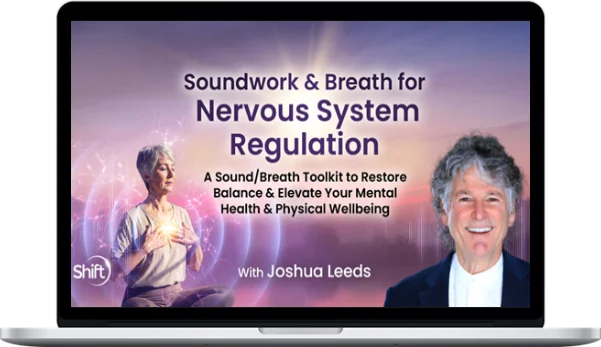
Joshua Leeds – Soundwork & Breath for Nervous System Regulation 2025
During this highly experiential course, you’ll:
- Uncover how vocal humming, breath patterns, the vagus nerve, and the autonomic nervous system interact — and why sound healers, sound therapists, singers, and breathworkers are uniquely positioned to benefit from understanding this gentle self-healing process
- Build your personalized Sound/Breath Toolkit — a flexible collection of techniques you can adapt to your unique nervous system’s needs
- Learn how regulating your autonomic nervous system — restoring harmony between your sympathetic (fight-or-fight) and parasympathetic (rest-and-digest) responses — helps counteract chronic stress and anxiety
- Experience a variety of sound and breath techniques that quickly restore balance and flow, whenever you need to ground, center, or uplift yourself
- Stimulate your vagus nerve with integrated breath and vocal practices to release stored tension, enhance stress resilience, and foster emotional and physical wellbeing
- Gain effective techniques to instantly shift your state, calming anxiety, increasing energy, or enhancing clarity in minutes
- Explore how sound and breathwork support vital functions like sleep quality, digestion, immune efficiency, bladder function, heart health, and more
- Unlock the sciences of psychoacoustics and bioacoustics, empowering you to harness sound and breath for deep healing
- Discover that music, sound, and other art forms deeply influence neurological pathways
- Recognize ways to engage in what Joshua calls “sonic activism” — using the Sound/Breath Toolkit in sound baths, drum circles, community sings, and private practice to foster social cohesion, unity, and positive change
- And much more…
What you’ll learn in Soundwork & Breath for Nervous System Regulation 2025
Module 1: Building Your Sound/Breath Toolkit — Foundational Techniques for Nervous System Harmony
Start your journey with Joshua’s Sound/Breath Toolkit, a game-changing method to regulate your autonomic nervous system and reclaim balance.
Learn the basic theories underlying sound and breath as remedies for sympathetic overload — the common parlance for an overwhelmed sympathetic nervous system, which chronically evokes the fight/flight/freeze response.
Joshua walks you through an overview of the many ways that sound and breathwork can help create a balanced autonomic nervous system — meaning homeostasis between the sympathetic and parasympathetic systems.
Begin putting innovative methodologies into your Sound/Breath Toolkit, as Joshua’s goal in this course is for you to identify and adapt activities of sound and breath that assist you on your important journey toward balance.
In this module, you’ll:
- Understand the link between stress and disease
- Learn breath ratio techniques to calm your nervous system
- Practice a personal self-help technique from the Sound/Breath Toolkit — “Seated Breath and Sound”
- Discover why stress and uncertainty lead to anxiety, and the sister relationship of sound and breath
Module 2: The Nervous System Unveiled – The Role of Sound & Breath in Autonomic Regulation
Your nervous system is your body’s unsung hero, running everything from your heartbeat to your breath — yet chronic stress and trauma can throw it into chaos.
Explore the autonomic nervous system, focusing on the symbiotic dance between its sympathetic “driver” and parasympathetic “brake” aspects.
Learn how sound — through vagus nerve vibration and breath endurance — restores balance, offering you a lifeline to calm and vitality.
As Joshua guides you through a powerful sound and breath technique, feel the shift as theory becomes practice, equipping you to combat stress overload and build resilience.
This is your key to understanding and mastering your body’s inner workings, ensuring you thrive no matter what life throws your way.
In this module, you’ll discover:
- A personal and fun self-help technique from the Sound/Breath Toolkit — “Bilateral Movement Part One” (sound, breath, movement, rhythm)
- The nervous system’s key divisions and their physical roles in your body
- How sound stimulates the vagus nerve for regulation
- The autonomic (sympathetic and parasympathetic) interplay of activation and rest
- How to build a foundation for stress resilience through mindful practice
Module 3: Tone, Breath & Movement in Action – How to Build Stress Resilience
Sound healing for nervous system regulation involves the reduction of sympathetic dominance and the building of stress resilience.
Heal yourself from sympathetic nervous system depletion, and build a stronger response mechanism to stress and trauma. By engaging in practices that strengthen both sympathetic (activation) and parasympathetic (recovery) responses, you can train your nervous system to handle stress better.
Joshua leads you through stress resilience exercises using sound and breath to improve your resilience, recover more quickly from stress, and boost your wellbeing.
Not only is our neurological center literally built for music and sound, but other art forms deeply influence neurological pathways and meeting grounds.
Experience stress resilience exercises demonstrating that tone affects the breath and movement impacts the brain. By putting tone, breath, and movement elements together, create strong physiological stimulators to use in unexpected situations for excellent organic results.
In this module, you’ll discover:
- A personal self-help technique from the Sound/Breath Toolkit — “Circadian Advantage Part One” (sound, breath, movement, rhythm, and circadian timing)
- The relationship between sound, breath, and movement
- A series of breath formulas for nervous system regulation
- The difference between nasal and mouth breathing
Module 4: Dr. Alfred Tomatis – How Active Listening & Passive Hearing Impact the Profound Benefits of Soundwork
Of all the contributors to the foundational principles of sound and music healing, Joshua’s favorite is the French ENT, Alfred Tomatis (1920-2001).
His memorable proclamations, such as “Sound is a nutrient for the nervous system,” and “The voice can only reproduce what the ear can hear,” changed the way Joshua perceives the power and impact of the auditory senses.
Tomatis’ core principles form the foundation of modern day sound-healing work. Explore some of his other sound therapy concepts, including how communication is a process that begins in utero.
Learn how the primary function of the ear is to charge the neocortex of the brain, and why the quality of your listening ability affects both spoken and written language development. Discern the distinction between hearing and listening — hearing is passive, listening is active.
Active listening abilities impact the way you move through your life.
In this module, you’ll:
- Be guided through a personal self-help technique from the Sound/Breath Toolkit — “Standing Tai Chi Part Two” (sound, breath, movement)
- Uncover Tomatis’ core ideas on sound as nourishment and communication
- Understand how Tomatis’s concepts form the theoretical psychological and physiological foundations of modern sound-healing work
- Explore the difference between active listening and passive hearing
- Listen to a sample of filtered and gated music based upon the Tomatis Method
Module 5: Polyvagal Power – The Vagus Nerve as Your Ally in Regulating Your Nervous System
Polyvagal theory, developed by Dr. Steven Porges in 1994, is a lens into how we experience threat and safety through the lens of the autonomic nervous system, and how we can work with these neurological mechanisms to rebalance the impact of stress or trauma.
Polyvagal theory is about how our nervous system shapes our behavior, emotions, and ability to connect with others.
Focus on the vagus nerve and its role in regulating the autonomic nervous system. Discover how sound and breath can “tonify” the vagus nerve, boosting resilience and deepening connections.
Through Joshua’s guided practices, experience a tangible shift, downregulating stress and unlocking inner peace.
This is your opportunity to turn theory into action, gaining tools to heal, connect, and flourish — even in a chaotic world.
In this module, you’ll:
- Experience a personal self-help technique from the Sound/Breath Toolkit — “Bilateral Movement Part Two” (sound, breath, movement, rhythm)
- Understand the polyvagal theory’s insights into your safety and stress responses
- Learn about specific vagal functions, heart rate, digestive activity, breath, and bladder health
- Recognize Porges and Tomatis as soundwork trailblazers
- Understand the vagus nerve’s role in parasympathetic harmony, and how to use sound and breath to strengthen vagal tone
- Explore the downsides and cautions to vagal nerve work
Module 6: 21st-Century Soundwork – The Role of Technology in Advancing Neuroscience & Sound-Healing Techniques
Sound healing is a big tent under which scientists, academics, musicians, therapeutic professionals, song leaders, choirmasters, shamans, and vibrational soundworkers gather.
With a rich lineage, this field of intentional music and sound recognizes the different approximations of vibration — the periodic movement found in all cells and galaxies.
All periodic movement has a frequency (vibratory rate), all frequency has a sound, and sound can be molded into music.
Sound healing is about combining these unified octaves for positive therapeutic applications for humans, animals, agriculture, and more.
In this module, you’ll discover:
- A personal self-help technique from the Sound/Breath Toolkit — “Standing Tai Chi Part One” (sound, breath and movement)
- The 20th-century scientists who greatly contributed to the field of sound healing, including Hans Jenny (cymatics), Alfred Tomatis (The Tomatis Method), Robert Monroe (binaural beat frequencies), Peter Guy Manners (vibroacoustic frequencies), and Olav Skille (vibroacoustic therapies)
- The 21st-century advances into neuroscience
- Soundwork principles, such as resonance, entrainment, and pattern identification
- Current sound-healing principles for people and animals
Module 7: Sonic Activism – Incorporating the Sound/Breath Toolkit Into Sound Baths, Drum Circles, Community Sings & Private Practice
There are many ways to make a difference in the world.
As musicians or vibroacoustic practitioners, we’ve chosen to use the sound arts as a means of effectuating a positive impact on friends and neighbors.
One facet of sonic activism is the creation of social cohesion by bringing communities of people together so they have the experience of unity — especially against the backdrop of cultural disruption, collective crises, or abrupt change.
In this module, you’ll explore:
- How to incorporate sound and breath and stress resilience exercises into the activities you facilitate
- A personal self-help technique from the Sound/Breath Toolkit — “Circadian Advantage Part Two” (sound, breath, movement, rhythm, and circadian timing)
- The role of sound and breath in personal and public healing spaces
- How to contextualize unity as a byproduct of social cohesion
- Four key exercises you’ve learned in this program
More courses from the same author: Joshua Leeds
Related products